
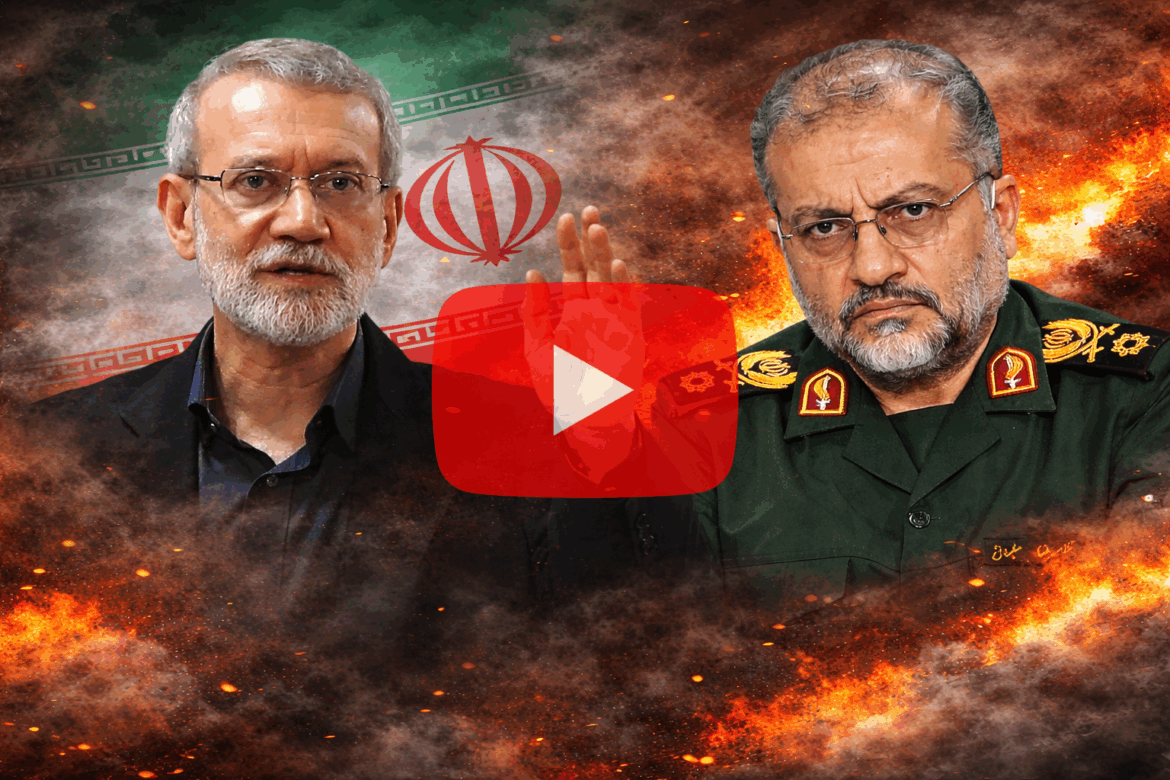
A Regime Breach, Not Just an Assassination
Something far more consequential than a single assassination has unfolded in eastern Tehran. The reported elimination of Ali Larijani—combined with the confirmed killing of Gholamreza Soleimani, commander of the Basij, and concurrent strikes on Basij-linked enforcement nodes—points to a systemic breach inside the Islamic Republic’s internal control architecture. This is no longer a story about deterrence or retaliation. It is about pressure on regime survival itself.
Simultaneous Strikes on Iran’s Command and Control Spine
According to Iranian opposition-linked reporting, Larijani was killed at approximately 3:00 AM in Pardis Phase 2 while meeting senior security officials to prepare for unrest tied to Chaharshanbe Suri—an annual event that has repeatedly served as a catalyst for anti-regime demonstrations. Within that same operational window, Soleimani was eliminated, removing the senior figure responsible for coordinating the Basij’s nationwide enforcement network.
At the same time, Israeli-linked operations reportedly targeted Basij checkpoints and internal control positions, including through the use of loitering munitions. Whether every tactical detail is confirmed matters less than the pattern that emerges. The campaign is no longer confined to degrading Iran’s external capabilities. It is now intersecting directly with the regime’s ability to control its own streets.
The Regime’s Survival Model: Redundancy Under Pressure
The Islamic Republic has historically survived crises through layered redundancy. During the 2009 Green Movement and the 2019 fuel protests, unrest reached dangerous levels—but the regime endured because its enforcement ecosystem remained intact. The IRGC provided strategic backbone, the police maintained formal order, and the Basij operated as a decentralized, rapidly deployable force embedded within neighborhoods.
The Basij is not simply a militia. It is the regime’s mechanism for translating authority into daily coercion—monitoring, intimidating, and suppressing at the local level. Its effectiveness depends on cohesion, command clarity, and the perception of omnipresence.
David Ben-Gurion once argued that strategic success often comes from forcing adversaries into internal strain—compelling them to divert attention and resources inward. What is now emerging inside Iran reflects that dynamic: a regime facing simultaneous external pressure and internal disruption.
Decapitation Meets Disruption: How Control Begins to Collapse
The removal of Larijani and Soleimani, combined with strikes on Basij infrastructure, produces a convergence that regimes are structurally ill-equipped to absorb.
Larijani represented coordination at the elite level—the connective tissue between political leadership and the security apparatus. Soleimani represented execution—the ability to mobilize force quickly across cities and neighborhoods. Eliminating both compresses the regime from top and bottom simultaneously.
This creates three immediate effects.
First, operational disruption. Without stable Basij leadership, enforcement becomes uneven. Local units hesitate, miscommunicate, or act inconsistently—precisely when rapid, coordinated response is most needed.
Second, institutional distrust. A regime that cannot protect senior figures begins to suspect internal penetration. Decision-making slows. Loyalty becomes a question rather than an assumption.
Third, psychological erosion. The Islamic Republic’s authority depends not only on force, but on the perception that resistance is futile. When checkpoints are struck and commanders eliminated, that perception begins to fracture.
This is the critical shift. The pressure is no longer peripheral. It is now acting on the mechanisms that sustain internal control.
From Street Control to Systemic Risk: Is Collapse Now Plausible?
In the immediate term, the regime will attempt to compensate through force. Expect rapid IRGC deployments, mass arrests, and communications restrictions. The objective will be to reassert control before unrest can scale.
But structural damage is not easily reversed.
Without coherent Basij command, localized enforcement weakens. Without trusted coordination at the top, strategic responses become slower and more reactive. And with evidence of deep intelligence penetration, paranoia spreads through the system.
This creates a conditional opening for regime change.
Regimes do not fall simply because they are attacked. They fall when their population believes that enforcement is no longer reliable—that fear no longer guarantees compliance. If disruption to the Basij continues, if leadership decapitation persists, and if public unrest accelerates during moments of cultural volatility, the regime may enter a cascading phase: hesitation at the top, fragmentation in the middle, and defiance at the street level.
For Israel, this presents both opportunity and risk. A weakened Iran is strategically advantageous. But a regime under internal threat often escalates externally to restore deterrence, increasing the likelihood of proxy conflict or regional escalation.
The key shift is now unmistakable. Iran is no longer managing internal stability from a position of control. It is reacting under conditions of disruption.
And when a regime begins to lose control of its streets, the question is no longer whether it is vulnerable—but how quickly that vulnerability becomes irreversible.