
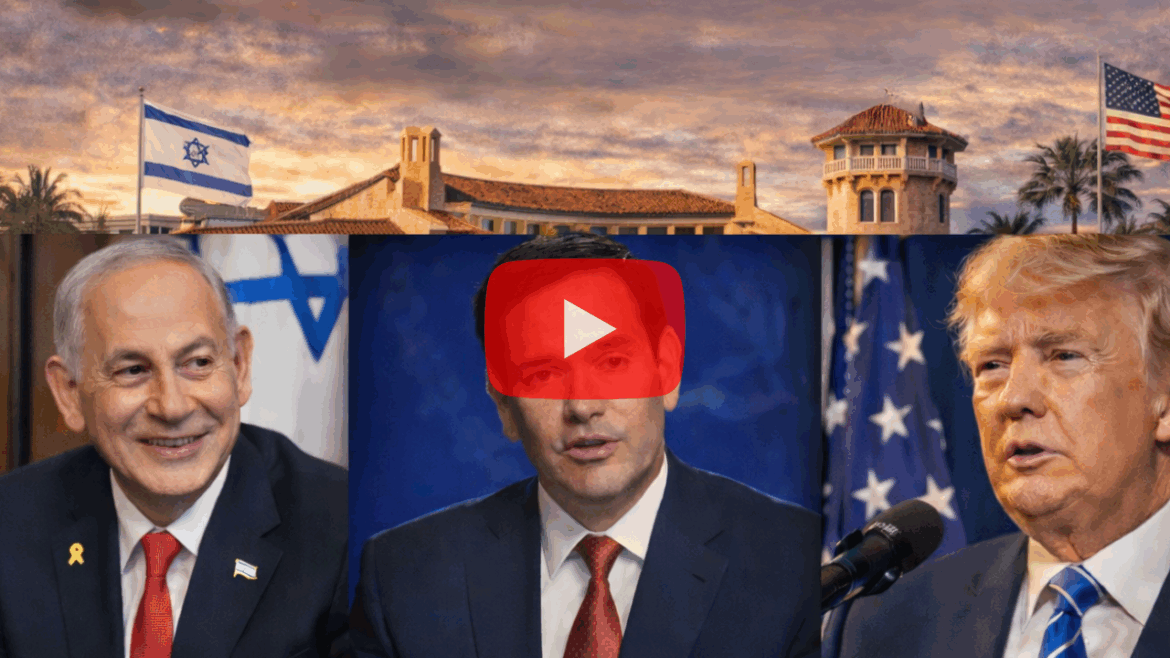
There are meetings, and then there are sorting moments. Today’s sit-downs at Mar-a-Lago between Benjamin Netanyahu, Marco Rubio, and Donald Trump fall squarely into the latter category.
Publicly, this is about Gaza’s so-called “phase two.” Privately, it is about enforcement—who does it, who guarantees it, and who pays the price when it inevitably meets resistance.
Trump has framed his Middle East ambitions in sweeping terms, calling his plan “a big, big day… potentially one of the great days ever,” promising that “we’re going to see something very special happen.” Netanyahu, standing alongside him earlier this month, was far more surgical: Israel supports the plan because it delivers “the return of the hostages and the dismantling of Hamas.” Those are not interchangeable goals. One is urgent. The other is non-negotiable.
Rubio’s role in the room matters precisely because he tends to say what others euphemize. His position has been consistent and blunt: “Hamas cannot continue as a military or government force.” That sentence is the meeting’s spine. Everything else—technocrats, reconstruction funds, international mechanisms—is scaffolding built around that demand.
Gaza Phase Two: Neutrality Is a Mirage
“Technocratic governance” will feature prominently in any post-meeting statement. It sounds safe, neutral, and responsible. In Gaza, it is none of those things. Administration without coercive power always borrows it—from militias, clans, or foreign patrons. Netanyahu understands this instinctively. Trump understands it politically.
The real dispute today is sequencing. Israel wants disarmament first and governance later. Washington, eager for visible progress, is tempted to reverse that order. Netanyahu has been clear that “what was before October 7 will not be again.” That is not rhetoric; it is a warning about timelines and red lines.
If there is movement on Gaza after today, it will be conditional and deliberately paced. Washington will signal progress without locking itself into timelines that assume Hamas compliance. Israel, for its part, will avoid any political handover that leaves Hamas structurally intact. Any interim authority will be framed as technical, temporary, and reversible—language designed to preserve leverage rather than resolve the conflict. Disarmament will sit quietly as the gatekeeper to everything else.
Syria: The Quiet Currency of the Meeting
Gaza cannot be read in isolation. If Israel is pressed to tolerate ambiguity there, it will seek certainty somewhere else. That “somewhere else” is Syria.
Trump has publicly emphasized stability and non-interference in Syria’s “evolution.” From Israel’s perspective, stability does not mean passivity. It means preventing southern Syria from becoming a vacuum filled by militias, Iranian remnants, or Turkish-backed Islamist structures. Turkey’s belligerency and expansionist instincts are not theoretical; Ankara has demonstrated repeatedly that it views Syrian territory as zones of influence rather than sovereign space.
Here is the likely trade: Netanyahu offers cooperation and message discipline on Gaza; Trump offers latitude without paperwork in Syria. Not declarations. Not press releases. Freedom of action.
In practical terms, this points to Israel quietly solidifying its control and presence within the buffer area adjacent to the Golan. Not as a declared annexation and not as a permanent political claim, but as a security fact on the ground. The objective is to deny hostile actors the space to embed themselves under the cover of governance, while allowing Washington to maintain the fiction of non-interference.
Demilitarization of southern Syria becomes plausible under this arrangement, but only as a functional reality rather than a signed agreement. Israel will enforce red lines—arms interdiction, deterrence strikes, persistent surveillance—while Washington avoids owning the policy publicly. Calm, in this framework, is achieved not through treaties but through sustained imbalance: Israel’s ability to act outweighing others’ ability to challenge it.
Minority protections fit into the same logic, with sharper constraints. For the Druze, Israel is unlikely to pursue formal political restructuring or open calls for autonomy. That would trigger resistance from Damascus and discomfort in Washington. What is achievable is protective deterrence—clear signaling that sectarian coercion or mass violence will provoke Israeli response, combined with humanitarian access and quiet coordination. Protection without proclamation.
The Kurdish question is more fraught. Kurdish security hinges almost entirely on how far Trump is willing to tolerate friction with Turkey. Sympathy is easy. Strategic backing is not. The most realistic outcome is limited protection through indirect means—restraining Turkish escalation rather than guaranteeing Kurdish sovereignty. Ankara’s reaction in the coming days will be the clearest indicator of how much space Washington actually granted.
The Bottom Line
What emerges from Mar-a-Lago is unlikely to be a peace architecture. It is a balancing act.
Gaza advances just enough to keep diplomacy alive, while Syria absorbs the hard security adjustments Israel requires to live with that ambiguity. If the arrangement holds, enforcement replaces declarations, and silence becomes the signal of success. If it fails—if Hamas reasserts itself or Syria destabilizes—Israel will move decisively, and the “process” will be exposed as temporary scaffolding rather than a solution.
That is the real test of today’s meetings. Not what is said in the photo op, but where Israel is allowed to act tomorrow—and whether anyone in Washington chooses to stop it.