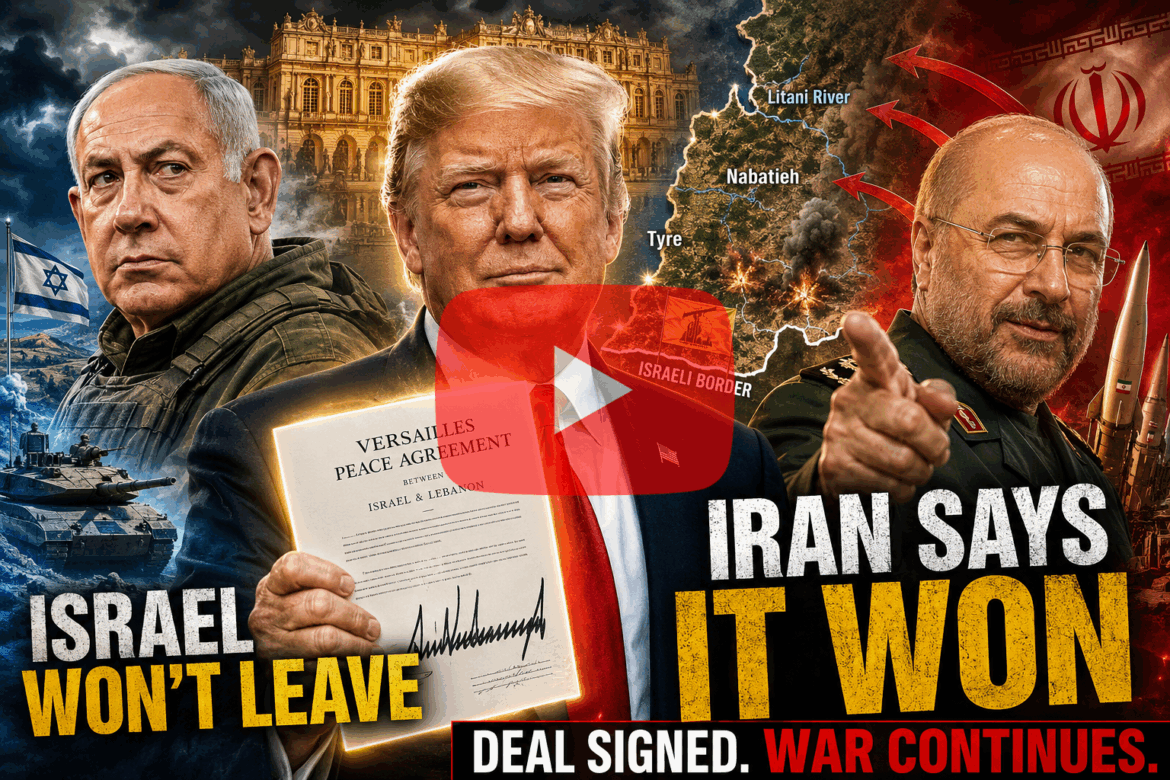
Versailles in Reverse: Why Iran Already Believes It Won
The signing of the new U.S.-Iran memorandum of understanding may be remembered as a diplomatic breakthrough in Washington and European capitals. In Tehran, however, it is being presented as something entirely different: a strategic victory over the United States, Israel, and the broader Western alliance.
That distinction matters.
The most important question is not what President Trump believes he signed in Versailles. The most important question is what the Iranian regime believes it achieved.
And based on the statements emerging from Tehran in the hours following the agreement, Iran’s leadership appears convinced that it emerged from the recent confrontation stronger, wealthier, and more strategically secure than before.
Iranian Parliament Speaker Mohammad Ghalibaf was remarkably blunt.
“The memorandum of understanding is the document of the United States’ defeat,” he declared. “Whoever opens fire will bear the consequences. Our fingers are on the trigger.”
Iranian Foreign Ministry spokesman Esmail Baghaei reinforced the message by insisting that Iran’s missile program remains entirely off limits, declaring that Iranian missiles are “meant to be launched, not negotiated over.”
That statement alone reveals one of the central weaknesses of the agreement. If Tehran retains its missile arsenal, retains its regional proxy network, preserves enriched nuclear material inside Iran, gains access to frozen assets, restores oil exports, and secures recognition of a role in managing the Strait of Hormuz, then many Iranian officials will understandably conclude that they successfully weathered the storm.
The Lebanon Problem
The most immediate challenge facing the agreement may not come from Washington or Tehran.
It may come from southern Lebanon.
Iranian officials have repeatedly declared that continued Israeli military operations in Lebanon constitute a violation of the memorandum. Baghaei specifically warned that Israeli actions against Hezbollah or continued Israeli presence on Lebanese territory could trigger consequences under the agreement.
This creates a fundamental contradiction.
Israel’s military leadership increasingly views the current security belt north of the border as essential to preventing another October 7-style threat from developing in southern Lebanon. The lessons of Gaza and Hezbollah’s October 8 attack remain deeply embedded within Israeli strategic thinking.
From Jerusalem’s perspective, withdrawing prematurely would recreate the very conditions that allowed Hezbollah to build its military infrastructure over the past two decades.
If Israel refuses to leave, Iran can claim the United States failed to uphold its commitments.
If Washington pressures Israel to leave, Netanyahu faces a direct challenge to Israel’s post-war security doctrine.
Either scenario creates friction that could destabilize the agreement before it fully takes effect.
Echoes of History
The symbolism of Versailles is impossible to ignore.
President Trump chose the same location associated with the 1919 Treaty of Versailles, the agreement that imposed punitive conditions on Germany after World War I. Historians have long argued that the treaty’s perceived humiliation contributed to the political conditions that fueled the rise of Adolf Hitler and ultimately World War II.
Yet Tehran is framing this agreement as the exact opposite.
Rather than being treated as the defeated power, Iranian officials are portraying themselves as the side receiving economic relief, diplomatic recognition, and strategic concessions.
Whether that narrative reflects reality is less important than the fact that Iranian leaders clearly believe it.
And nations that believe they have won tend to behave differently than nations that believe they have been deterred.
The Turkish Factor
Another largely overlooked variable lies to Israel’s north.
Should Washington intensify pressure on Israel to withdraw from southern Lebanon, a power vacuum could emerge. Syria’s new leadership, backed by Turkey’s growing regional ambitions, may view such a vacuum as an opportunity.
Ankara has steadily expanded its influence across northern Syria, Iraq, Libya, the Caucasus, and parts of Africa. Turkish-backed forces moving into portions of Lebanon under the banner of stabilization would dramatically alter the regional balance.
For Israel, replacing Hezbollah influence with Turkish influence may solve one problem while creating another.
What Comes Next
The coming months will determine whether this memorandum becomes a durable agreement or merely a temporary pause before the next confrontation.
Iran clearly believes it won.
Israel clearly believes it cannot compromise on security in Lebanon.
President Trump appears determined to prove diplomacy can succeed where pressure alone could not.
Those three assumptions cannot all remain true indefinitely.
Sooner or later, one side’s interpretation of the agreement will collide with reality.
And when it does, the distance between diplomacy and military confrontation—as Ghalibaf himself warned—may prove far shorter than many policymakers currently assume.