
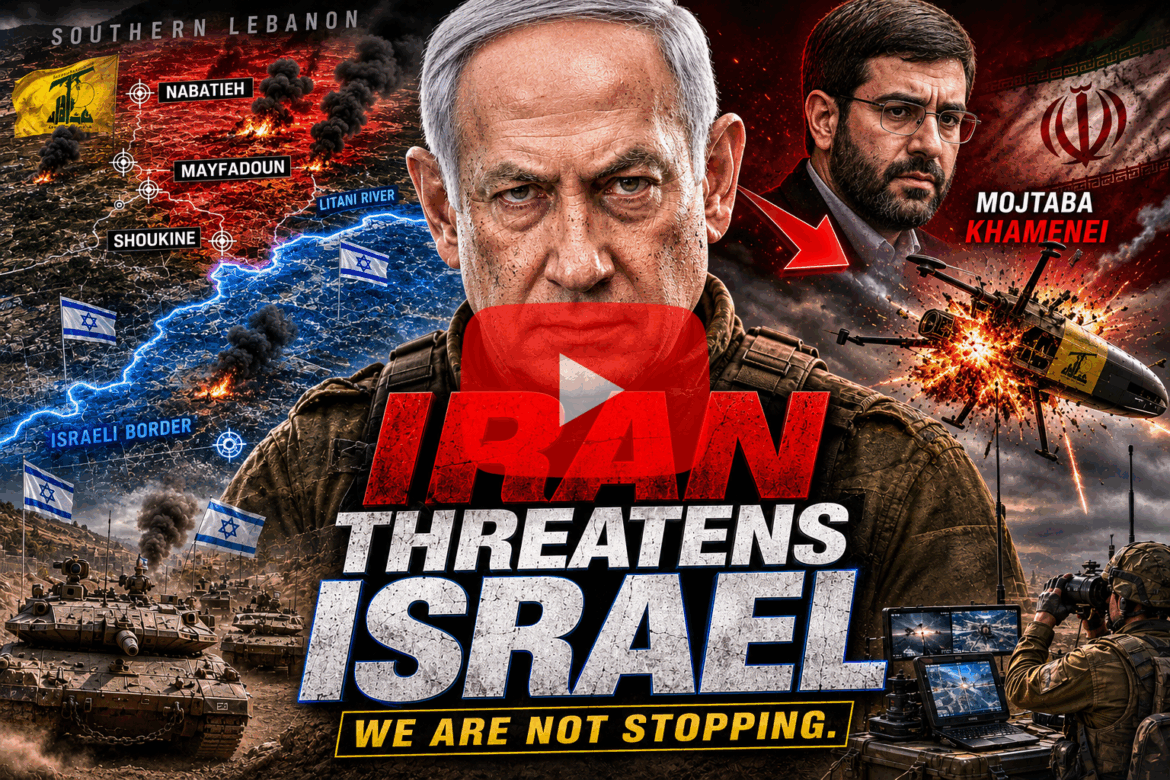
The latest Hezbollah rocket, mortar, and anti-tank missile attacks against Israeli forces operating in southern Lebanon are not isolated battlefield incidents. They are part of a broader strategic contest unfolding across the northern front—a contest that increasingly centers on drones, terrain control, and the question of how far Israel is willing to go to establish a sustainable security buffer beyond its border.
While Hezbollah’s attacks caused no Israeli casualties and most incoming fire was intercepted, the significance lies elsewhere. Hezbollah is signaling that it intends to contest every additional kilometer of Israeli military activity north of the current security line. Israel, meanwhile, appears equally determined to deny Hezbollah the freedom to rebuild the operational infrastructure that made October 7-style threats possible on the northern border.
The Drone Battlefield Takes Center Stage
For years, Hezbollah invested heavily in rockets, anti-tank missiles, and underground infrastructure. More recently, however, Iranian planners have emphasized drones as the next generation of asymmetric warfare.
Southern Lebanon’s rugged hills, valleys, and villages provide ideal terrain for launching surveillance and attack drones toward northern Israel. Areas surrounding Nabatieh, Mayfadoun, and the broader central sector have increasingly become focal points because they serve as logistical corridors connecting Hezbollah positions to deeper support networks north of the Litani River.
The IDF’s response today reflects a familiar pattern. Hezbollah operatives approached Israeli forces in multiple locations, often using civilian vehicles and terrain masking techniques. Israeli airpower responded immediately, striking what the military described as “immediate threats” before attacks could be executed.
The reported strikes near Mayfadoun and Shoukine demonstrate that Israel is increasingly targeting not only launch teams but also the broader movement network that supports Hezbollah operations.
Lessons From the Security Zone Era
Israeli policymakers understand that history offers important lessons.
During Israel’s previous security zone presence in southern Lebanon from 1985 until 2000, control of strategic ridgelines and observation points often proved more important than controlling population centers.
The challenge today is different. Hezbollah possesses precision-guided munitions, sophisticated surveillance capabilities, and a drone arsenal that did not exist during the 1990s.
As a result, Israeli military planners appear to be adopting a layered strategy: destroy launch infrastructure, dominate key terrain, and create enough operational depth to disrupt Hezbollah’s ability to position drone units close to the Israeli border.
This would explain the increasing reports of Israeli activity beyond previously established operating areas.
The Message Behind Tehran’s Threat
Perhaps the most significant development is not Hezbollah’s rocket fire but Iran’s warning.
In an official statement, Tehran declared that continued Israeli operations in southern Lebanon could trigger a “harsh response” from Iran’s armed forces.
Such statements are designed to achieve several objectives simultaneously.
First, they reassure Hezbollah supporters that the organization is not standing alone.
Second, they attempt to deter further Israeli advances by raising the possibility of regional escalation.
Third, they test whether international actors—particularly Washington and European governments—will pressure Jerusalem to halt operations before Israel achieves its military objectives.
Yet Iran faces constraints of its own. Direct intervention carries substantial risks, particularly at a time when Tehran remains focused on preserving strategic assets across multiple fronts.
What Comes Next
The most likely scenario is a gradual Israeli expansion of operational control across additional sectors of southern Lebanon aimed specifically at suppressing Hezbollah’s drone infrastructure.
Rather than a dramatic armored thrust toward Beirut or the Litani River, Israel is more likely to continue a methodical campaign focused on ridgelines, launch corridors, observation points, and logistical routes.
The strategic objective appears increasingly clear: create conditions in which Hezbollah cannot effectively threaten northern Israel with drones, anti-tank missiles, or cross-border infiltration.
If successful, Israel would establish a new security reality similar in principle—but not in geography—to previous buffer-zone concepts.
The critical question is whether Hezbollah and Iran decide to absorb these losses or escalate in an effort to prevent a permanent shift in the balance of power along Lebanon’s southern frontier.
The answer may determine the shape of the northern battlefield for years to come.