Whatsapp
For ten days, across five major Florida campuses, I witnessed something deeply painful and profoundly hopeful.
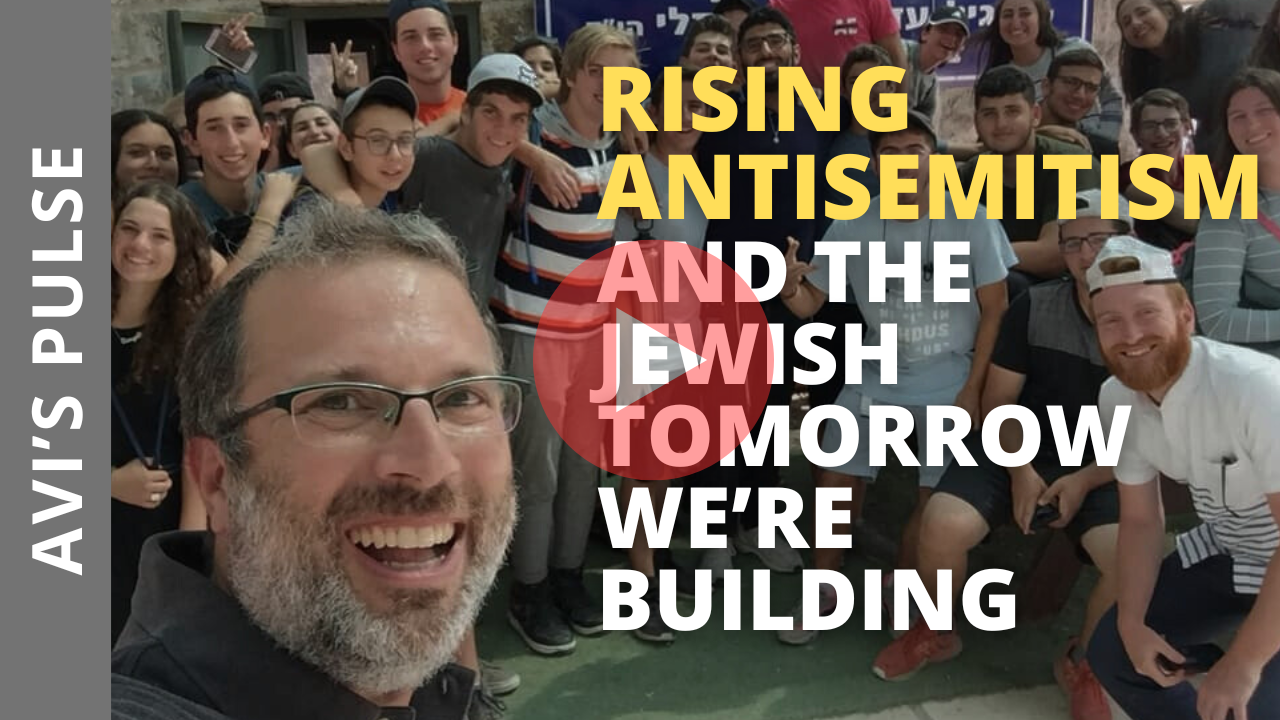
A special speaking tour brought together Religious Zionist activists from Israel, including Rabbi Jeremy and Tehila Gimpel, Rabbi Aaron Sokol, Rabbi Josh Wander, Chabad Shaliach in Heron Rabbi Danny Cohen and me. Initiated by philanthropist Lewis Topper, the tour carried a clear message to Jewish students: Strengthen your Jewish identity, understand what is happening to America and Israel, and begin seeing your future as part of the Jewish story unfolding in our ancestral homeland.
What made this initiative so powerful was the partnership between two essential forces.
Chabad on Campus is doing extraordinary work helping Jewish students connect with their identity, often reaching unaffiliated young Jews who arrived at college with little Jewish education. We came from Israel to complement that sacred work by explaining the inspiring truth about Israel today: not merely the country portrayed in hostile headlines, but the miraculous center of Jewish history, sovereignty and destiny.
What we encountered should concern and inspire every Jew.
Antisemitism is awakening Jewish souls
On every campus, most of the Jewish students we met said they had experienced Jew-hating antisemitism since October 7.
Yet many are responding not by abandoning their identity, but by seeking it.
They are attending Shabbat dinners at Chabad, putting on tefillin and asking questions about Judaism and Israel that they had never seriously considered before. October 7 and its aftermath have shaken their assumptions, but that shock is also awakening something within them.
The Jewish soul is stirring.
Many of these students still lack the language and education necessary to understand what they are experiencing. They know the atmosphere has changed. They feel hostility that did not exist, or was less visible, before October 7. They see classmates and professors turning against Israel and sometimes against them personally.
But almost nobody is explaining why.
Students are told that the hostility is simply a “reaction” to October 7 and Israel’s subsequent war in Gaza. That explanation makes no sense on its own.
Jihadist terrorists invaded Israel, massacred families, raped, burned and kidnapped Jews, and almost immediately, the fury of the streets and campuses was redirected against Israel and the Jewish people, weeks before Israel began a military offensive in Gaza.
The victims became the accused.
Young Jews who had just witnessed the greatest massacre of Jews since the Holocaust found themselves expected to apologize, defend their identity or condemn the Jewish state while the blood of their people was still fresh.
How did that inversion happen?
No Jewish institutions or leaders are giving students the broader ideological context.
The alliance transforming the West
Students see the hostility on campus, but few are taught about the forces transforming America, particularly the red-green jihadi alliance between radical progressive movements and jihadi organizations united in their hostility toward Israel, Western identity and biblical values.
These movements disagree profoundly on many social questions, yet they have found common enemies.
The radical progressive Left views America and Israel as inherently oppressive nations that must be dismantled or fundamentally transformed. Islamist movements seek greater religious and political power while presenting themselves through the progressive language of victimhood, liberation and social justice.
Israel becomes the bridge connecting them.
That is why Hamas’s Oct. 7 massacre could be reframed almost immediately as “resistance.” It is why students chanting for an intifada are treated as activists for justice, while Jewish students defending Israel are accused of supporting oppression.
American Jews recognize that something has changed, but most do not understand the process. They are like deer caught in headlights, stunned that the America they trusted is turning against them.
For generations, American Jews were raised to believe that America was different from every previous diaspora and that their acceptance was permanent. That belief makes it extremely difficult to recognize a historic transformation while living through it.
The America I left
I understand that emotional attachment to America because I lived it.
I left the United States after September 11, 2001, when many of us believed America had finally understood the danger of jihadist ideology.
I had already been warning about the Muslim migration/immigration threat for years. In 1997, I wrote a letter to the editor of the New York Jewish Week after watching the same forces begin destroying Western Europe.
Then came September 11.
For a brief moment, it appeared that America had awakened. Yet instead of confronting the ideology behind the attacks, much of the political, academic and media establishment gradually returned to denial, political correctness and appeasement.
The America I visited on this tour is dramatically different from the one I left.
Its biblical foundations, national identity and relationship with Israel are under attack from both sides of the political spectrum. The radical Left increasingly portrays America and Israel as oppressive. Meanwhile, isolationist and conspiratorial voices on the Right increasingly blame Israel and the Jews for America’s wars and internal problems.
America remains an extraordinary country filled with millions of faithful, patriotic people. But the ideological transformation I warned about almost three decades ago is no longer theoretical.
Ignoring it will not make it disappear.
From supporting Israel to experiencing Israel
We did not arrive expecting students to hear one lecture and immediately decide to move to Israel.
Only a few voiced serious thoughts about aliyah at this stage. Most wanted knowledge, confidence and reassurance as they confronted the challenges of being Jewish on campus.
Adults attending our programs asked practical aliyah questions: Where should we live? How can we find employment? Which schools would suit our children?
Students were generally at an earlier stage. They asked about the US-Israel relationship, the importance of living in Israel, how they could visit Israel etc.
Those questions matter.
Our goal was to help them understand Israel not merely as a distant country they are expected to defend, but as the center of the Jewish future, a place where they can fulfill themselves not only professionally, but also as Jews participating in the destiny of their people.
Birthright, study programs and internships are not tourism alone. They allow young Jews to experience Jewish national life firsthand. They begin transforming Israel from an abstract political cause into their homeland.
The perspective of an immigrant
Someone born in Israel may understandably take Jewish sovereignty for granted.
I cannot.
I understand what it means to leave America: family, familiarity, language, professional comfort and the society in which you were raised. Aliyah is emotionally and psychologically difficult.
But I also understand what immigrants discover after arriving in Israel.
You are not merely changing countries. You are coming home and becoming an active participant in the most extraordinary chapter of Jewish history in 2,000 years.
For centuries, Jews prayed toward Jerusalem while living at the mercy of foreign rulers. Today, we raise Jewish families in our ancestral homeland, defend ourselves with a Jewish army and help shape the policies of a sovereign Jewish state.
That privilege is beyond words.
Students hungry for answers
Several students approached us after the programs and thanked us for presenting information they had never heard before.
What stayed with me was not one dramatic encounter, but the repeated sense of relief.
They knew something had changed, yet nobody had provided the framework to understand it. They deeply appreciated hearing a broader explanation of Israel today, the hostility they were experiencing and the ideological transformation of America and the West.
Knowledge gave them confidence.
They no longer had to view each Jew-hating antisemitic incident as an isolated eruption or conclude that Israel had somehow caused the hatred now directed at them. They could begin recognizing the forces at work and responding as informed, proud Jews rather than frightened students constantly placed on the defensive.
The most important pushback
Some students strongly challenged our message.
They argued that Jews must remain in America to influence its politics, defend American values and preserve the US-Israel relationship. They worried that if too many Jews moved to Israel, Jewish political influence in America would weaken.
Others raised a deeper fear rooted in Jewish history: If all Jews eventually lived in one small country, would concentrating the Jewish people in Israel make us more vulnerable to being wiped out by our enemies?
These are sincere concerns, and I respect them.
But Jewish sovereignty fundamentally transforms our historical reality.
For 2,000 years, Jews were dispersed and defenseless, lobbying foreign rulers and hoping that political influence would protect us. Sometimes it helped. Eventually, in almost every exile, it failed.
Our national purpose is not fulfilled primarily through diaspora communities lobbying foreign politicians. It is fulfilled by living as a sovereign Jewish nation in the Land of Israel and building a society grounded in Jewish faith, morality and responsibility.
That is how we can most profoundly influence humanity.
Jews can and should make positive contributions wherever they live. But the Jewish people’s long-term future cannot depend primarily upon influence in foreign capitals. It must be built through sovereignty, strength and national responsibility in our ancestral homeland.
Planting seeds for the future
Several adults told me that our conversations strengthened their determination to move to Israel with their families.
A number of students said they were now seriously considering Birthright as a first step toward experiencing Israel and deepening their Jewish identity.
That matters, but it is not the only measure of success.
The impact of this tour may take years to become visible. We were planting seeds. Those seeds must now be watered.
Each of us held individual conversations with students after the programs. We provided sign-up sheets so they could remain connected after the tour. Chabad emissaries on campus will continue their daily work of building relationships, strengthening Jewish identity and creating Jewish community.
Our responsibility is to remain in contact with those who demonstrated serious interest and help connect them with trips, study programs, internships and aliyah opportunities.
Inspiration without follow-up fades. Inspiration connected to relationships and practical opportunities can change a life.
Come home, do not merely run away
There is one danger we must avoid.
If our message focuses only on Jew-hating antisemitism and insecurity in America, aliyah can sound like an escape.
That is not my message.
I do not tell Jews, “Run away from America.”
I tell them, “Come home to Israel.”
Jew-hating antisemitism may force people to reconsider assumptions, but fear alone cannot sustain aliyah. Israel must be presented positively and truthfully as the center of Jewish history, identity, responsibility and destiny.
Israel has enormous challenges. We face war, political division and deep institutional struggles over the Jewish character of the state.
But our future is bright.
Our children defend their people, volunteer in hospitals and schools, build communities and participate in the rebirth of Jewish sovereignty. We do not live in Israel merely to survive persecution. We live there to rebuild the Jewish nation and fulfill the mission entrusted to us.
That is not an escape.
It is an invitation to come home and participate in Jewish history.
The awakening has begun
The most inspiring lesson from this tour is that the Jewish soul remains alive.
Young Jews who received little Jewish education are searching for meaning. Students facing hostility are walking into Chabad houses. Adults who built comfortable lives in America are beginning to ask practical questions about aliyah.
The awakening is real.
But awakening must lead to responsibility.
Jewish students need more than arguments explaining why Israel is not guilty. They need to understand who they are, why Israel exists and how their personal lives connect to the destiny of the Jewish people.
That is why initiatives like this campus tour are so important. They unite Chabad’s extraordinary work of awakening individual Jewish souls with a proud message from Israel about Jewish national purpose.
The Jewish future will not be secured merely by fighting antisemitism.
It will be secured by building Jewish identity, strengthening faith and connecting the next generation to Israel, not only as supporters, but as participants.
The doors are open. Jerusalem is rebuilt. Jewish sovereignty has returned.
The invitation now stands before every Jew:
Come visit. Come learn. Come work. Come build.
And, ultimately, come home.
Am Yisrael Chai!!!