
The month-long lull between the United States and Iran appears to be ending.
President Donald Trump vowed Monday that the United States would respond forcefully after Iran launched missiles at American forces stationed in Jordan, the latest escalation in a six-month conflict that has increasingly centered on control of the Strait of Hormuz.
“We’re going to hit them hard,” Trump told Fox News, later making clear that “there will be a response.”
The immediate exchange is important, but the larger strategic picture matters far more.
Iran continues to keep the Strait of Hormuz closed, attempting to use one of the world’s most important maritime chokepoints as leverage against Washington and the international community. The United States, meanwhile, has maintained its naval counter-blockade against Iran while threatening additional economic sanctions.
Neither side has backed down.
The latest Iranian attack came after US forces struck Iranian military assets that Washington said were preparing to deploy mines in the Strait of Hormuz. Tehran claimed that two people were killed and several others wounded in those strikes.
Iran responded by firing missiles toward a US base in Jordan. Trump said almost all of the incoming missiles were intercepted.
But Iran did not limit its retaliation to American forces.
Tehran also launched missiles toward the United Arab Emirates overnight and continued its attacks Monday. Emirati authorities reported intercepting an Iranian drone over UAE waters, with no reported damage.
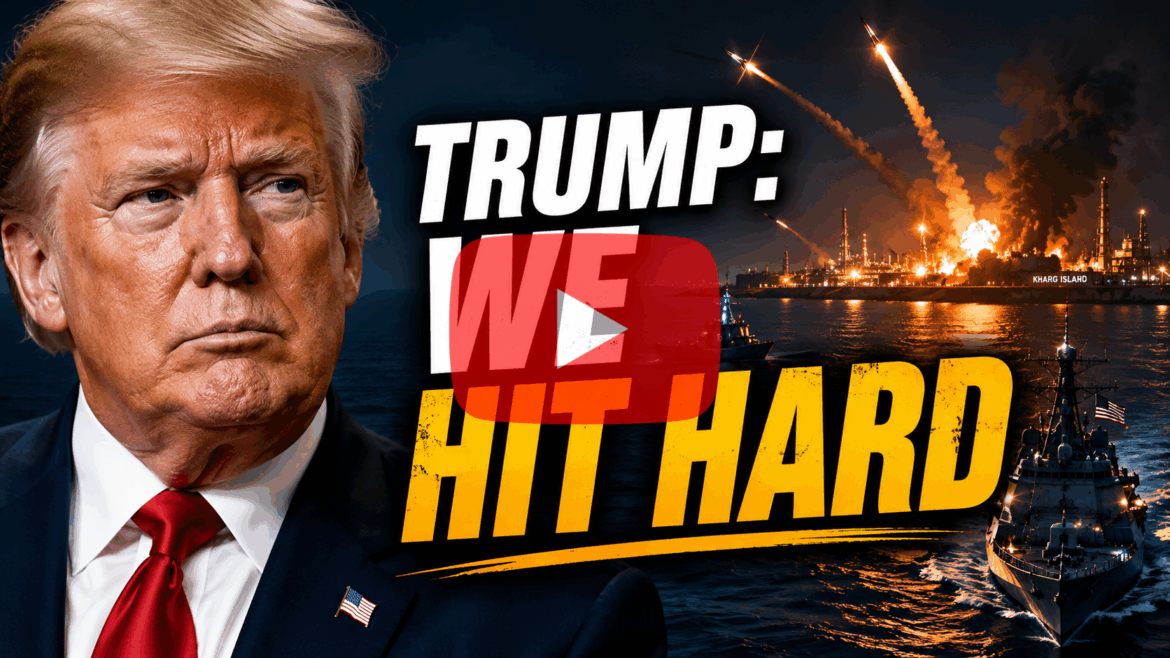
Trump also posted AI-generated footage depicting an attack on Iran’s strategically important Kharg Island. Vice President JD Vance later characterized the video as “a message to the Iranians,” rather than a preview of an already-approved American military operation.
That message, however, fits the broader trajectory of the conflict.
The struggle is no longer simply about individual missile launches or isolated military strikes. It is increasingly a contest over whether Iran can successfully weaponize the Strait of Hormuz and force Washington and its regional allies to accept Tehran’s terms.
Trump’s warning suggests Washington has no intention of doing so.
The next American strike may therefore be designed not simply as retaliation, but as another step toward breaking Iran’s ability to maintain its blockade of the Gulf.