
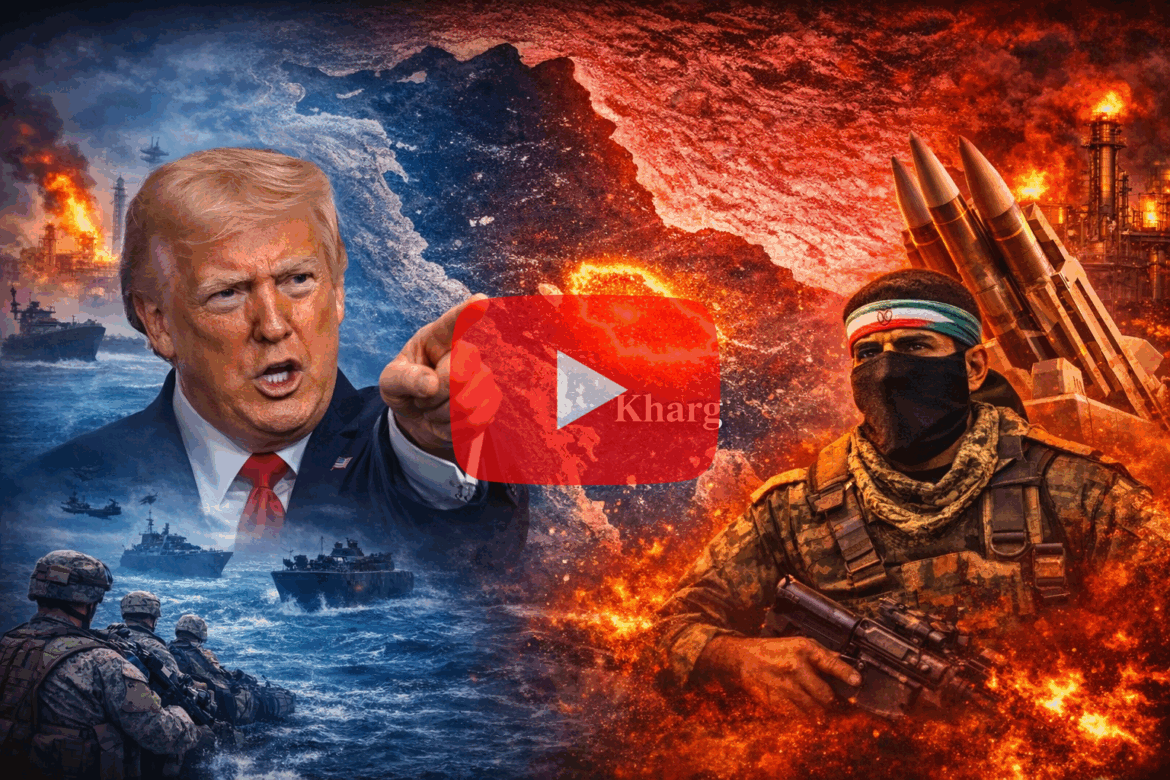
The Island That Could Decide the Gulf War
When Iran publicly warns the United Arab Emirates that its ports may become targets because U.S. forces are operating from them, the message is not only directed at Abu Dhabi. It is also a signal to Washington: Tehran is preparing to expand the battlefield across the Persian Gulf. In that context, one strategic option inevitably enters the conversation in Washington’s war rooms—whether the United States should seize Kharg Island, the nerve center of Iran’s oil exports.
If President Donald Trump were to order U.S. Marines to capture Kharg Island, it would represent a dramatic but logical escalation in the emerging confrontation between Washington and Tehran.
Strategic Background
Iran’s statement declaring that it has a “legitimate right…to attack hostile U.S. missile launch sites located in ports, docks, and bunkers within several cities in the United Arab Emirates” reflects Tehran’s traditional escalation pattern. When unable to strike American forces directly in decisive ways, Iran threatens the economic arteries of the Gulf.
Kharg Island is the most critical of those arteries.
Located roughly 25 kilometers off Iran’s coast, Kharg handles the majority of Iran’s oil exports. Its terminals, storage facilities, and loading infrastructure form the backbone of the regime’s ability to fund both its government and its regional proxy network.
The Iranian warning that civilians should evacuate ports where American forces are present suggests Tehran understands that Gulf infrastructure is now part of the battlefield. That logic cuts both ways. If Iranian leaders believe Gulf ports hosting U.S. forces are legitimate targets, American strategists will inevitably consider whether Iran’s own strategic infrastructure—beginning with Kharg Island—should be neutralized or even seized.
Historical Context
The strategic importance of Kharg Island is not new. During the Iran-Iraq War in the 1980s, the island became the focal point of the so-called “Tanker War.” Iraq repeatedly bombed Kharg in an attempt to cripple Iran’s oil revenue and weaken its ability to sustain the conflict.
Despite heavy damage, Iran managed to keep exports flowing.
For American planners, that lesson matters. Simply striking Kharg from the air may not permanently disable it. Physically occupying the island—even temporarily—would have a far more decisive effect.
Israel’s founding prime minister David Ben-Gurion often emphasized the centrality of geography in Middle Eastern strategy. Control the key terrain, he argued, and political outcomes eventually follow. Kharg Island is exactly that kind of terrain: small, exposed, and economically decisive.
Strategic Analysis
Why might Trump consider such a move?
First, seizing Kharg would strike directly at the financial lifeline of the Iranian regime. Iran’s ability to fund the Islamic Revolutionary Guard Corps, regional militias, and missile development depends heavily on oil revenue. Removing Kharg from the equation would immediately tighten the regime’s economic constraints.
Second, the operation would signal that the United States is willing to escalate vertically, not just horizontally. Iran’s strategy has long relied on threatening shipping, energy infrastructure, and regional partners. Taking Kharg would flip that pressure directly onto Tehran.
Third, it would reassure Gulf allies that Washington intends to protect the maritime energy corridor rather than merely defend against attacks.
However, the risks are real.
Kharg Island is likely defended by Iranian coastal missiles, drones, naval mines, and Revolutionary Guard naval units. Amphibious landings are among the most complex military operations, and even against a weaker opponent they carry risk.
Yet the balance of power is stark. The United States controls the skies, fields overwhelming naval power, and possesses extensive amphibious assault capability. Iran could attempt to harass such an operation, but stopping it outright would be difficult.
Projected Outcomes
If the United States seized Kharg Island, the consequences would reverberate far beyond the Persian Gulf.
Iran’s oil exports could collapse overnight. Global energy markets would spike, but Tehran’s ability to finance war would shrink dramatically.
Iran would likely retaliate through asymmetric attacks—missiles, drones, cyber operations, and proxy forces across the region. However, the regime would also face a strategic dilemma: escalating further risks inviting even deeper American strikes on critical infrastructure.
In the broader Middle East balance, the message would be unmistakable.
For decades Iran has relied on threatening the Strait of Hormuz to deter external pressure. A U.S. seizure of Kharg Island would invert that equation.
Instead of Iran threatening the world’s oil supply, Washington would be holding Iran’s.