
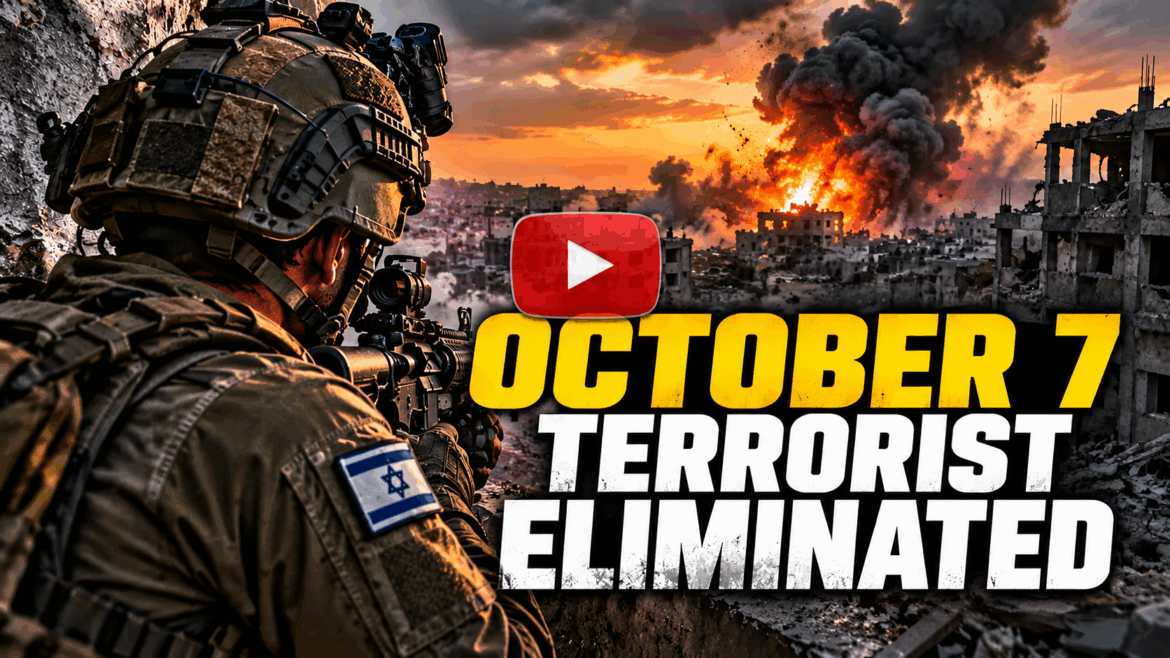
Israeli strikes target Hamas operatives involved in the October 7 massacre, sniper operations, and anti-tank missile attacks as the terror organization continues attempting to rebuild its military capabilities.
The IDF announced Saturday that it had eliminated four Hamas terrorists in a series of targeted strikes across the Gaza Strip over recent days. Among those killed was a Hamas operative who infiltrated Israel during the October 7 massacre.
According to the IDF Spokesperson’s Unit, the four terrorists were actively involved in planning attacks against Israeli soldiers and civilians while working to restore Hamas’s military infrastructure despite the existing ceasefire agreement.
On Thursday, Israeli forces eliminated Mahmoud Khaled Mohammed Madhoun, a member of Hamas’s elite Nukhba force. Throughout the war, Madhoun participated in combat operations against IDF troops, including launching anti-tank missiles at Israeli forces.
On Friday, the IDF eliminated Ubaida Suheil Hamad Murtaja, a sniper operative within Hamas’s military wing. In a separate strike, Israeli forces killed Adham Khalil Mohammed Maarouf, a Hamas terrorist who participated in the October 7 invasion of southern Israel.
On Saturday, the IDF eliminated a fourth Hamas operative, Abdel Jawad Gouda, who was also affiliated with the organization’s military wing.
The military emphasized that all four terrorists had recently been involved in advancing attacks against Israeli forces and civilians while attempting to rebuild Hamas’s operational capabilities.
Hamas Is Using the Ceasefire to Rebuild
The significance of these eliminations extends beyond the removal of four individual terrorists.
The IDF’s announcement highlights a fundamental challenge facing Israel in Gaza: Hamas continues attempting to regenerate its military infrastructure even under a ceasefire framework.
Sniper teams, anti-tank units, and experienced Nukhba operatives remain critical components of Hamas’s ability to threaten Israeli soldiers and potentially conduct future attacks.
The elimination of an October 7 participant is particularly significant. Nearly three years after the massacre, Israel continues pursuing those responsible for the invasion and the murder and abduction of Israeli civilians.
These operations also demonstrate that the IDF is maintaining intelligence and operational capabilities throughout Gaza, allowing it to identify and strike specific threats.
A Ceasefire Cannot Become a Shield for Hamas
The broader strategic question remains whether any ceasefire arrangement can succeed while Hamas retains the ability to recruit, rearm, and rebuild.
Israel’s experience since October 7 has demonstrated the danger of allowing terrorist organizations to exploit periods of relative calm to prepare for another confrontation.
The IDF stated that Southern Command forces remain deployed in accordance with the existing agreement and will continue operating to eliminate threats to Israel.
The strategic reality is straightforward: a ceasefire that allows Hamas to reconstruct its military capabilities cannot provide lasting security for southern Israel.
As long as Hamas retains armed operatives and the infrastructure necessary to launch attacks, Israel will face an ongoing requirement to disrupt the organization’s rebuilding efforts.
The elimination of these four terrorists represents another step in that campaign. But the larger objective remains unchanged: preventing Hamas from once again becoming a military force capable of carrying out another October 7.