
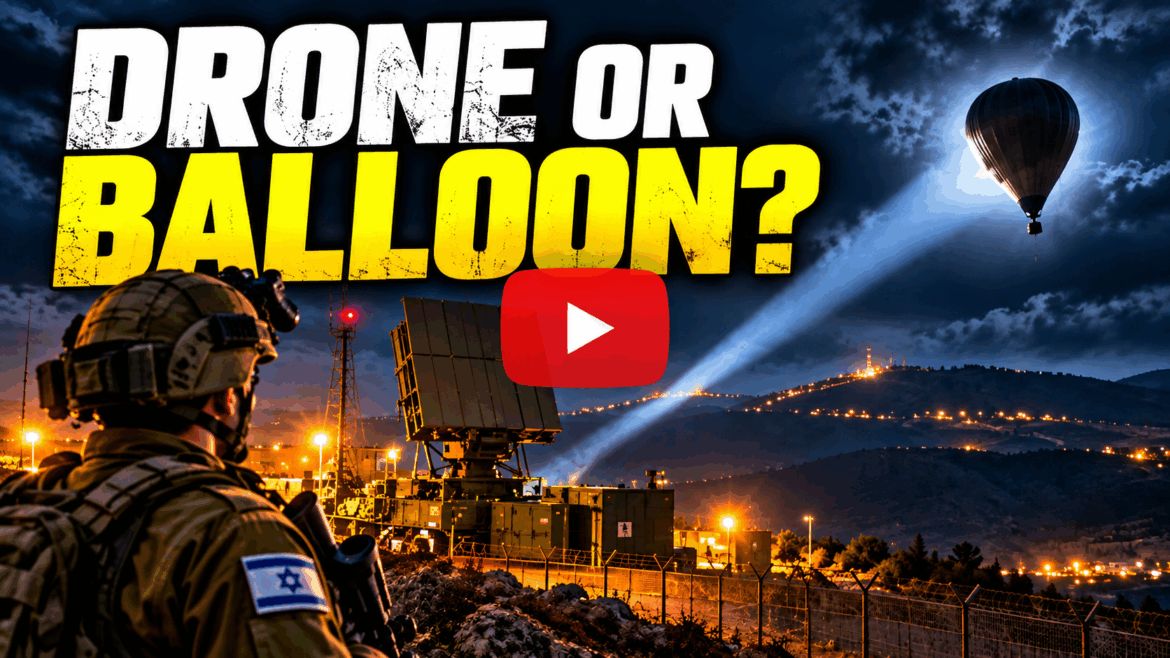
What began as an unidentified flying object over Israel’s northern border has ended with a surprising assessment by the IDF: the object that triggered air raid sirens in Arab al-Aramshe, near the Lebanese border, was most likely a balloon.
But the incident reveals something far more significant about Israel’s security posture along its northern frontier.
Following an extensive investigation, the IDF determined that the unidentified object was probably a balloon-like device, possibly one using hot air to remain airborne. The military ruled out the possibility that it was a drone or UAV, although it could not establish where the object originated or what purpose it served.
The object itself has not been recovered.
Nevertheless, the Israeli Air Force’s surveillance systems detected and tracked it, directing ground forces as they responded. Security was reinforced in nearby communities until the immediate investigation was completed.
There were no changes to Home Front Command instructions.
The real story, however, is not the balloon. It is the operational reality Israel now faces along the Lebanese border.
For years, Hezbollah invested heavily in building an aerial threat against Israel, developing reconnaissance capabilities, explosive drones, and increasingly sophisticated methods of penetrating Israeli airspace.
October 7 demonstrated the catastrophic consequences of dismissing warning signs, underestimating enemy intentions, and allowing uncertainty to delay defensive action.
Israel cannot afford to repeat those mistakes in the north.
The IDF acknowledged that distinguishing between a hostile drone and an ordinary bird can be extraordinarily difficult. Detection systems must make rapid assessments, sometimes within seconds, while commanders weigh the potential consequences of allowing an unidentified object to continue flying.
That explains the recent false aerial alerts and interceptor launches over southern Lebanon.
It also highlights a fundamental military dilemma: an overly cautious response can waste expensive interceptors and disrupt civilian life, while a delayed response to an actual attack could cost Israeli lives.
The challenge is not simply detecting threats. It is identifying them accurately without sacrificing the speed necessary to defeat them.
There is also a larger strategic question.
Israel’s northern communities cannot return to a permanent reality in which every unidentified object crossing the Lebanese border potentially sends families running for shelter.
Military technology must improve, but technology alone cannot resolve the underlying security problem. Israel must maintain the intelligence, operational freedom, and forward defensive posture necessary to prevent hostile forces from rebuilding their capabilities near its border.
The IDF says it continues examining its detection systems and conducting searches to improve its identification capabilities.
That is necessary. But the ultimate measure of success will not be how efficiently Israel distinguishes balloons from drones.
It will be whether Israel can create a northern security reality in which its enemies no longer possess the capability to threaten its communities.
A balloon may have triggered the sirens this time.
The next object might not be so harmless.