
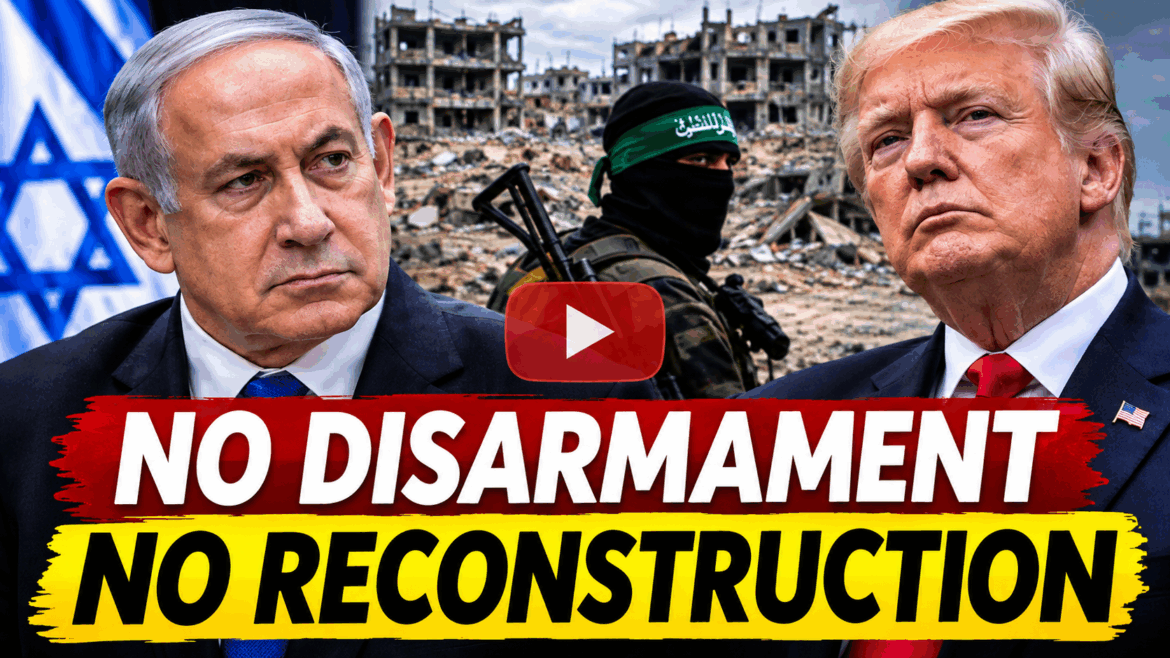
Israel has delivered a clear message to President Donald Trump and his Board of Peace: Gaza cannot be rebuilt while Hamas remains armed, entrenched, and capable of turning international humanitarian assistance into the infrastructure of its next war against Israel.
In a statement released by the Prime Minister’s Office, Benjamin Netanyahu reaffirmed Israel’s commitment to Trump’s 20-point peace plan. But he also made clear that reconstruction cannot begin until Hamas surrenders its weapons, relinquishes control of Gaza, and the territory is demilitarized. C14
This is more than a diplomatic condition. It is a strategic necessity.
For years, the international community poured billions into Gaza under the assumption that economic development would eventually produce moderation. Instead, Hamas transformed civilian infrastructure into military assets, building an extensive underground network and preparing for war.
According to the Prime Minister’s Office, Hamas has yet to surrender a single weapon. Israel also accuses the terrorist organization of diverting humanitarian resources for military purposes, including using cement for tunnels, water pipes for rocket launchers, and sewage equipment for weapons production.
The Israeli statement further accused the United Nations and UNRWA of turning a blind eye to this diversion. These are allegations made by Israel, but they underscore the fundamental challenge confronting Trump’s reconstruction initiative. C14
The problem is not a shortage of international assistance. The problem is who controls the territory receiving that assistance.
Israel has continued facilitating humanitarian preparations for Gaza’s winter, including a reported 91,000 tents, more than 8,200 truckloads of winter supplies, sewage pumping equipment, fuel, and infrastructure repairs.
Yet every shipment of dual-use materials presents a potential security risk while Hamas retains operational control.
This creates a critical test for Trump’s Board of Peace.
Will the international community finally recognize that reconstruction without demilitarization simply finances the next conflict? Or will diplomatic pressure once again fall on Israel to accept arrangements that leave the underlying terrorist infrastructure intact?
The strategic lesson of October 7 must not be forgotten.
Israel cannot permit Hamas to rebuild its military capabilities under the cover of humanitarian recovery. Nor can Jerusalem outsource its security to international guarantees that lack credible enforcement.
Trump’s plan offers an opportunity to fundamentally change Gaza’s future. But that opportunity depends on enforcing the very conditions that make lasting stability possible.
Israel must insist on verified disarmament, the dismantling of terrorist infrastructure, and the permanent removal of Hamas from governing authority.
Humanitarian assistance should continue under rigorous safeguards. Long-term reconstruction, however, must be tied to demonstrable security changes.
The choice is straightforward: rebuild Gaza as a civilian society free from Hamas’s military control, or risk rebuilding the foundations of the next war.
Israel cannot afford another experiment in wishful thinking.