
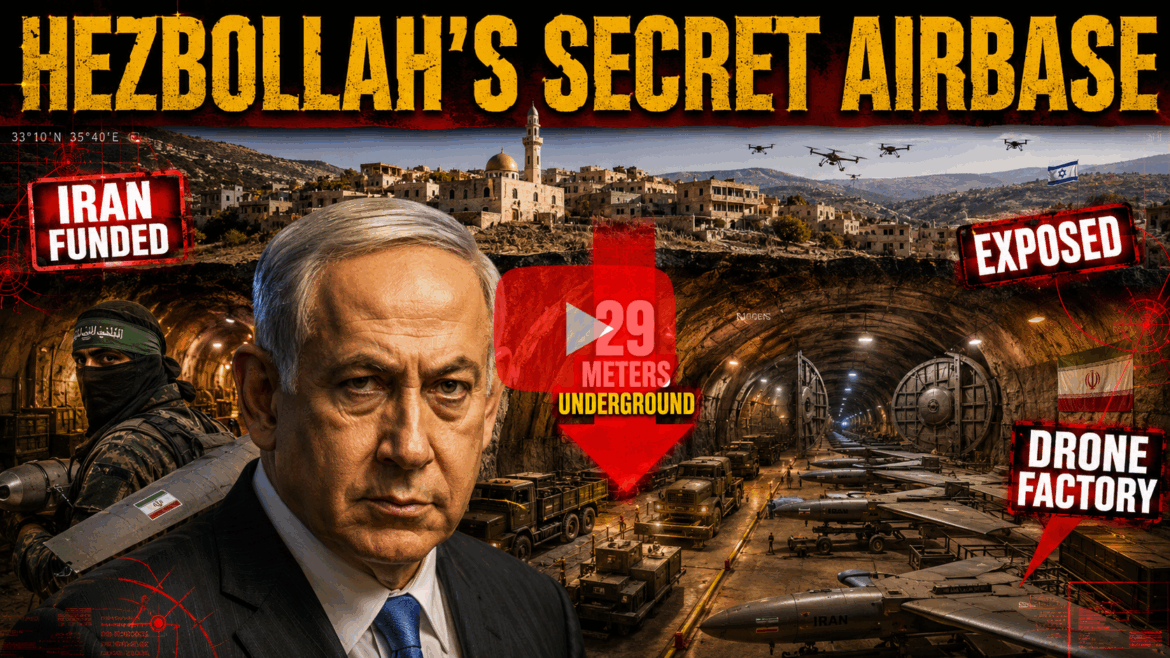
Deep beneath the hills of southern Lebanon, only a few kilometers from Israel’s northern border, Hezbollah constructed a sophisticated underground drone facility designed to support its ongoing campaign against Israel.
According to Israeli military officials, the subterranean complex was built over the past decade with direct Iranian assistance, including planning, engineering expertise, and financial support. The facility was recently revealed during an organized media tour conducted by the Israel Defense Forces.
Located beneath the village of Majdal Zoun, the underground installation extends several hundred meters into the mountain and reaches depths of approximately 29 meters (95 feet) below the surface. Israeli officials said portions of the tunnel system run beneath civilian infrastructure, including a local mosque.
The complex was designed to function as a concealed drone “airbase,” allowing Hezbollah operatives to assemble, store, and deploy Iranian-made unmanned aerial vehicles while remaining protected from aerial surveillance and attack.
Massive steel blast doors secured the facility, while the tunnels themselves were wide enough to accommodate standard vehicles. According to the IDF, Hezbollah used the site to assemble drones from components smuggled into Lebanon, many originating from Iran.
Israeli military officials argue that the discovery provides further evidence of Iran’s extensive involvement in Hezbollah’s military buildup and highlights the growing role of unmanned systems in the regional conflict. Drones have become an increasingly important tool in Hezbollah’s arsenal, enabling surveillance operations and attacks against Israeli military and civilian targets.
The exposure of the facility underscores the scale of Hezbollah’s military infrastructure in southern Lebanon and the challenges facing efforts to enforce international resolutions requiring the disarmament of armed groups operating south of the Litani River.
For Israeli security planners, the tunnel complex represents more than a tactical threat. It serves as a reminder of the deep strategic partnership between Tehran and Hezbollah and the continuing effort to establish advanced military capabilities along Israel’s northern frontier.