
Israel faces a historic decision. Another diplomatic agreement with Tehran could give the Iranian regime the time it needs to rebuild its strength and threaten the Jewish state once again.
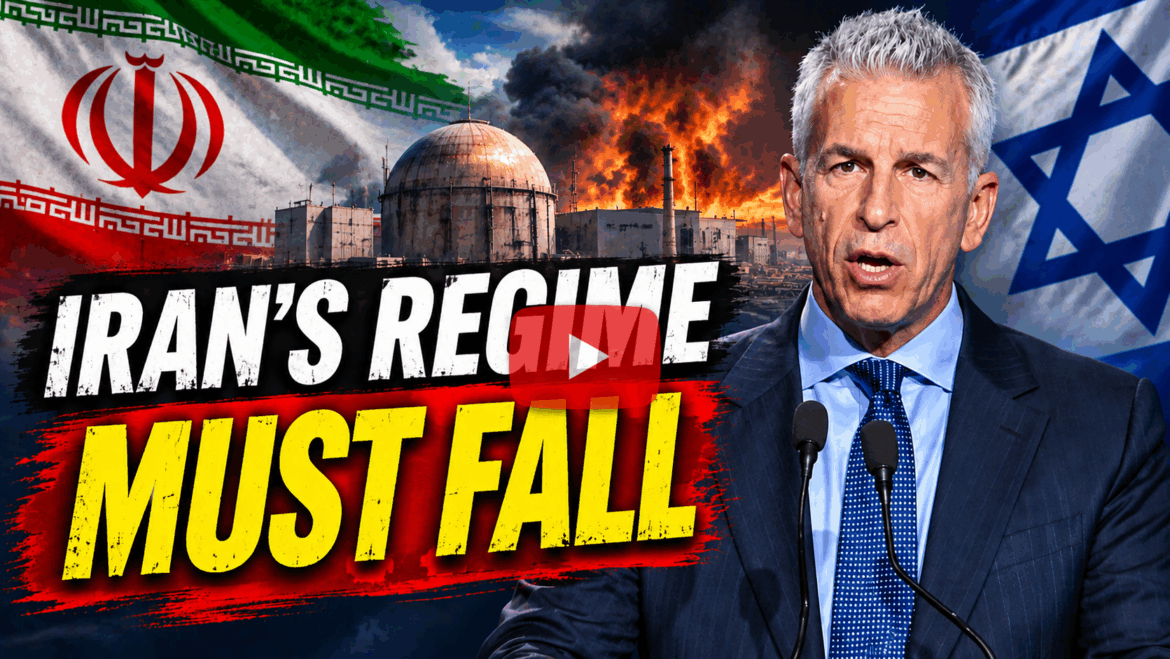
Former Mossad chief David (Dadi) Barnea has delivered one of the clearest warnings yet about the Iranian threat: Israel must be prepared to bring down the Islamic Republic’s ruling regime, even if doing so requires another war.
Speaking at the ELNET conference in Jerusalem, Barnea argued that the international community can no longer afford to believe that diplomatic agreements will fundamentally change Tehran’s ambitions. According to Channel 14, he called for decisive action when the necessary military and diplomatic conditions are in place.
But Barnea’s warning points to something far more significant than another confrontation between Israel and Iran. It exposes the central failure of Western strategy toward the Islamic Republic.
The problem is not simply Iran’s nuclear program. The problem is the regime itself.
For decades, Western governments have approached Iran as though its revolutionary leadership could eventually be persuaded to behave like a conventional nation-state. Sanctions, negotiations, economic incentives and diplomatic pressure have all been employed in the hope that Tehran would abandon its ideological confrontation with Israel and the West.
Yet the Islamic Republic has consistently treated negotiations as another instrument of strategic competition.
Under Mojtaba Khamenei, the fundamental question remains unchanged: Can a revolutionary regime committed to regional domination ever be trusted with the capabilities necessary to threaten entire nations?
Barnea’s answer is unequivocal. He warned that a diplomatic agreement would not eliminate the regime’s underlying nuclear ambitions.
Israel Is Only the First Target
Perhaps the most important element of Barnea’s remarks was his warning to Europe.
A nuclear-armed Iran would not merely threaten Israel. It could place European capitals under the shadow of nuclear coercion, fundamentally altering the balance of power across the Middle East and beyond.
The danger is not limited to whether Tehran would actually launch a nuclear weapon. Possessing such weapons could give the regime greater freedom to intimidate neighboring countries, protect its regional proxies and challenge Western interests.
This is precisely why Israel’s confrontation with Iran cannot be understood as an isolated regional dispute.
Israel stands on the front line of a much larger struggle between Western civilization and a revolutionary Islamist regime that has spent decades exporting instability and terrorism.
Washington Must Abandon the Illusion
President Donald Trump now faces a strategic choice.
Washington can return to the familiar cycle of sanctions, negotiations and temporary agreements, or it can recognize that lasting regional security may require a fundamental transformation of Iran’s political leadership.
That does not mean rushing blindly into another war.
Even Barnea emphasized that military action must account for the broader strategic and diplomatic circumstances.
But there is an enormous difference between preparing carefully for decisive action and using diplomacy to postpone an unavoidable confrontation.
Israel must ensure that Iran cannot rebuild its nuclear capabilities, restore its strategic deterrence or use another agreement to buy time.
The Historic Opportunity
The collapse of the Islamic Republic would not automatically guarantee a peaceful or democratic Iran. Regime change carries serious risks, including instability and the possibility of a dangerous successor.
Nevertheless, allowing a hostile revolutionary government to acquire nuclear weapons presents risks of an entirely different magnitude.
Israel’s leadership must therefore work with Washington to establish a clear strategic objective: permanently eliminate Iran’s ability to threaten Israel with nuclear weapons while creating the conditions for the Iranian people to determine their own future.
The Jewish state cannot outsource its survival to international guarantees, diplomatic promises or the goodwill of foreign governments.
The lesson of October 7 is that Israel cannot afford to mistake temporary quiet for lasting security.
Barnea’s warning should be understood as a call to abandon strategic illusions.
The question is no longer whether Iran’s regime poses a threat.
The question is whether Israel and the United States possess the determination to confront that threat before the price becomes immeasurably greater.