
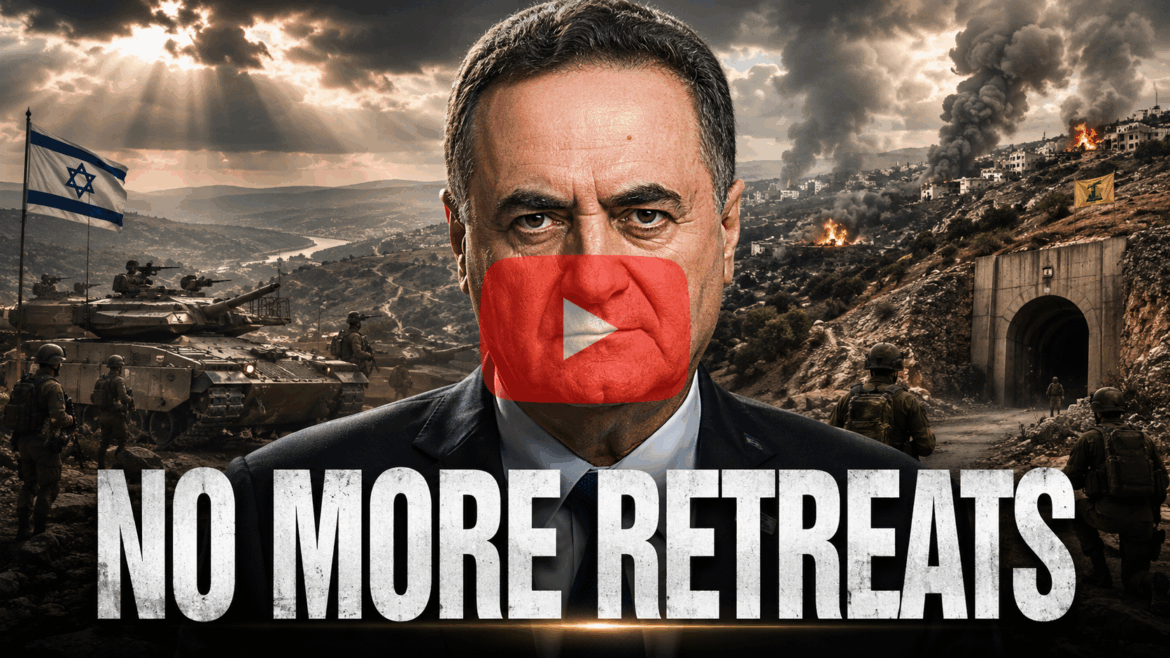
Defense Minister Israel Katz has delivered Israel’s clearest strategic message since the new Israel-Lebanon framework was signed: Israel’s security—not diplomatic timelines—will determine the future of southern Lebanon.
His position is straightforward. Israel has no interest in occupying Lebanese territory, but neither will it repeat the mistakes that allowed Hezbollah to rebuild after previous wars.
As Katz stated:
“People should not hold their breath wondering where the next place will be from which Israel will withdraw in Lebanon, because it will not happen until Hezbollah is disarmed. We have no territorial ambitions in Lebanon, but until Hezbollah is disarmed we will not withdraw a millimeter.”
That statement reflects a fundamental shift in Israeli doctrine. The objective is no longer simply deterring Hezbollah. The objective is preventing Hezbollah from ever again establishing a military threat along Israel’s northern border.
According to Katz, this policy is not being pursued in isolation. He says the United States has accepted Israel’s position and that it is embedded within the military annex of the new agreement between Israel and Lebanon.
Following his meeting with U.S. Central Command Commander Adm. Brad Cooper, Katz revealed another significant strategic understanding:
“The IDF will not withdraw from the three security zones — in Lebanon, Syria, and Gaza.”
This suggests Israel increasingly views these fronts as part of one integrated regional security architecture rather than separate conflicts.
Katz also expressed little confidence that the Lebanese Armed Forces will dismantle Hezbollah’s military infrastructure.
“The Lebanese army refused to do it.”
He was referring to Israel’s request that Lebanese forces enter the Ali Taher Ridge and clear Hezbollah operatives from one of the organization’s largest underground tunnel complexes. According to Katz, roughly thirty Hezbollah terrorists remain inside those tunnels while the IDF continues controlling the surrounding area.
His comments reinforce what Israel has argued for years: Lebanon’s state institutions remain unwilling—or unable—to confront Hezbollah where it matters most.
Katz also described the extensive destruction of Hezbollah’s frontline strongholds along the border.
“It was clear that the Shiite villages along the line of contact had to disappear.”
According to the defense minister, nearly every Hezbollah village directly facing Israel in the western and central sectors has been destroyed, while approximately 73 percent of similar villages in the eastern sector have also been demolished.
He further stated that approximately 600,000 Shiite residents from southern Lebanon have fled their homes, while another 700,000 have been displaced from Hezbollah’s Dahiyeh stronghold in Beirut.
Perhaps Katz’s most revealing comments concerned the final stages of Israel’s campaign against Hezbollah.
He argued that Israel had prepared a much larger offensive that, in his assessment, would have completely broken Hezbollah’s military capabilities.
“When President Trump linked Iran and Lebanon, we stopped bringing down buildings in Beirut. The linkage between the arenas is an American interest, and these are the constraints of the partnership with the United States.”
He added:
“If there had not been a linkage between the Lebanon and Iran arenas, Hezbollah would have collapsed.”
According to Katz, pressure from President Trump during discussions with Prime Minister Benjamin Netanyahu resulted in linking the Lebanon campaign to broader negotiations with Iran, forcing Israel to adjust its operational plans.
“I was not on the fifth call, and the president applied pressure that ultimately created the linkage between the arenas.”
Instead, Israel shifted to what Katz described as “plan B”—expanding military operations north of the Litani River while enlarging Israel’s security zone with American approval rather than pursuing Hezbollah’s total military collapse.
Even so, Katz made clear that Israel’s campaign is far from over.
“More tunnels to destroy and blow up.”
Among them is Hezbollah’s massive underground complex beneath the Beaufort Ridge, which Katz says will eventually be destroyed using approximately 500 tons of explosives.
Finally, Katz warned that Israel is fully prepared should Iran choose to intervene directly.
“It could happen even within two days.”
While emphasizing that Israel will not interfere with President Trump’s diplomatic approach toward Tehran, Katz stressed that the IDF has already prepared targets inside Iran and stands ready to act independently if Iran launches ballistic missile attacks against Israel.
Taken together, Katz’s briefing reveals Israel’s emerging strategic doctrine: maintain permanent security depth where necessary, deny Hezbollah any opportunity to rebuild, preserve operational freedom against Iran, and treat Lebanon, Syria, Gaza, and Tehran as interconnected fronts within a single regional campaign.
The message from Jerusalem is increasingly clear: Israel is no longer measuring success by ceasefire agreements. It is measuring success by whether its enemies retain the capability to threaten Israeli citizens again.